
Disabled UD student dissatisfied with campus accommodations
Disabled UD student dissatisfied with campus accommodations
Lauren McCarty ’26 | Arts & Entertainment Editor
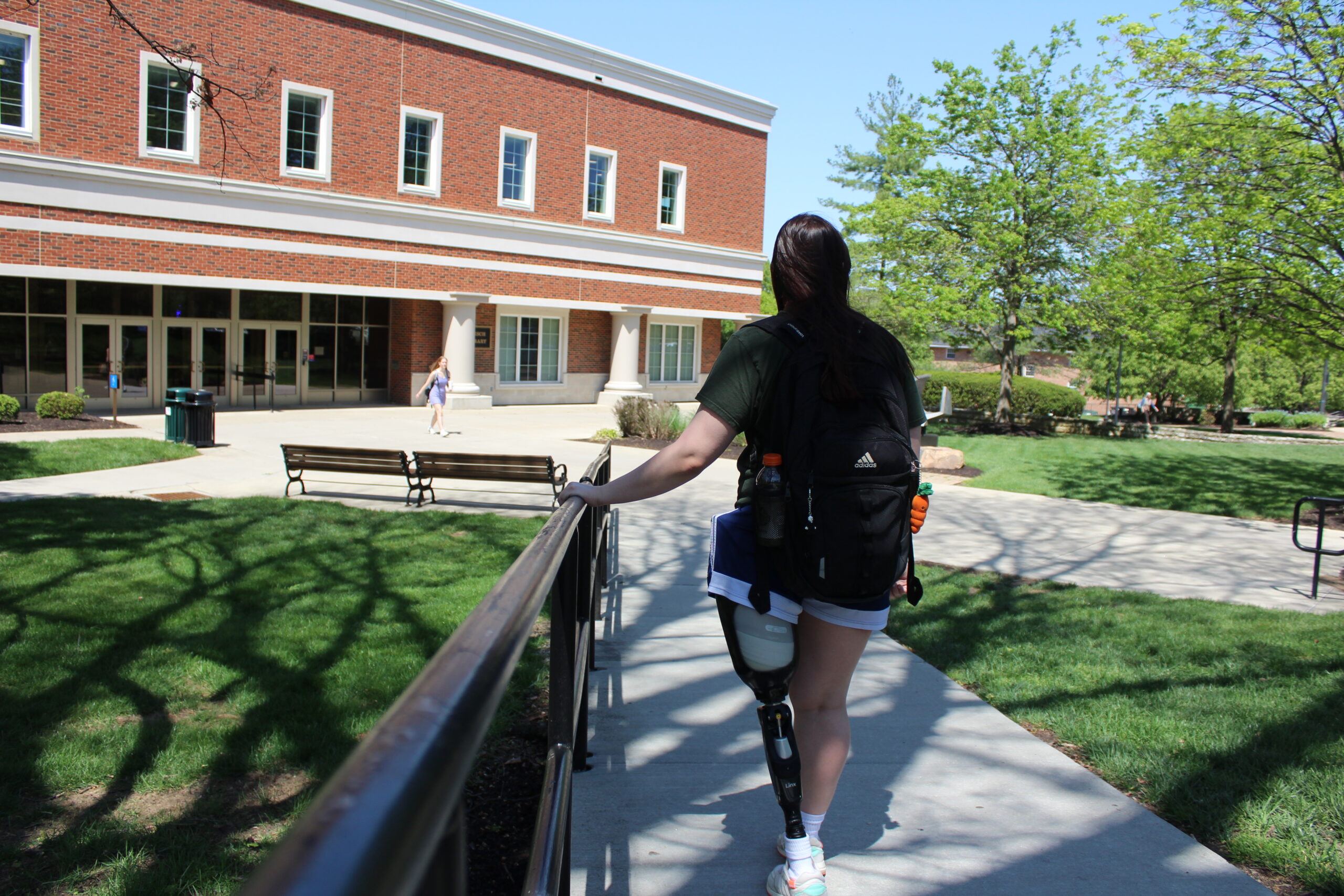
Senior Paige Hendryx faces many challenges in her daily life with a prosthetic leg. Hendryx, an English major from Cleveland, Ohio, feels dissatisfied with UD’s disability services.
Hendryx is a cancer survivor. Her journey ended with her having to make the difficult decision to have her left leg amputated.
Attending UD while getting used to walking on a prosthetic leg has been a physical and mental challenge for Hendryx, who feels dissatisfied with UD’s level of care. Hendryx attempted to advocate for herself, and many of her requests required parental or professor intervention to be completed.
“Every day is different for a disabled student. I just wish that the university kind of was more understanding and made you jump through less hoops to get the things that you need,” Hendryx said.
Prosthetics pose a unique set of challenges for their owners. A wearer typically deals with balancing and stability difficulties as well as decreased stamina. Adjusting involves muscle soreness, fatigue, irritation, and swelling. Adapting to the new limb poses the risk of falls. Reaching full comfort and confidence in walking can be a year-long process. When the artificial limb comes off at the end of the day, crutches or a cane are required.
Her accommodations requests were simple: priority parking and an accessible room. Housing accommodations were met with a second and third request at times, but Hendryx’s main grievance rests with her parking situation.
Although Hendryx has a state-issued handicap placard and a UD parking permit, she was denied a UD handicap parking pass; she was ticketed for using a handicap spot on a day when walking to class was not an option per her physical state.
The process for obtaining a university-issued handicap pass is to go through the OLR, which communicates with parking services to issue the pass.
Assistant director of access and disability services Deanna Arbuckle was asked why a student in this condition might be denied a pass, to which she responded:
“We have to think about what the actual university community is like, and being able to look at that. And what are an individual’s needs with regard to that?” Arbuckle said.
“If we’re talking about where I’m parking with respect to my residence, versus, say, a class, we’re not on a campus where people are likely going to be driving from parking lot one to parking lot two to parking lot three between classes. With regards to that, that may be part of that perspective. It may be again, it may be a case of what the availability is.”
Hendryx was not given priority parking, and her car rests in a lot that is the 3rd closest to her apartment, while 2 large lots with handicap spaces are across her residence. She cannot park her car anywhere other than the designated area on campus during university hours.
When asked if there is a way to prioritize a physically handicapped person’s needs regarding parking and housing, Arbuckle stated, “Who would get to choose then what priority is put in place? So if I’m blind, do I get the priority? If I’m deaf, do I get a priority? If I’m physically disabled, do I get a priority? How do we determine which person gets the best priority?
Arbuckle said that students dissatisfied with decisions like this may appeal for reconsideration. After sitting in the OLR office with her prosthetic visible and being denied these accommodations, Hendryx felt defeated and unmotivated to appeal for help.
“I can’t always change how somebody feels or how they perceive that interaction. I just hope that if it’s important to them, that they’re willing to take the steps and have those conversations.” Arbuckle said.
According to a study published by the National Disability Center for Student Success, for disabled students in the U.S, fewer than half of those who applied for accommodations ultimately received them. These gaps reveal how fragile the system is when accessibility is treated as individual compliance instead of a shared campus responsibility.”
Hendryx expressed the strain of having to advocate for herself and navigate the systems and policies.“Jumping through all these hoops as a disabled person makes it very frustrating,” Hendryx said.
“Institutionally, we continue to listen and try to advocate for all students. So if I ever become aware of a population that has not found this to be, there are people, offices, and units that will intervene immediately.” Dr. Tiffany Taylor, Vice President of Diversity, Equity, and Inclusion, said.
“We’re making efforts, but if there are areas where we have blind spots, when it’s brought to our attention, there are folks who can respond accordingly. Taylor said.