
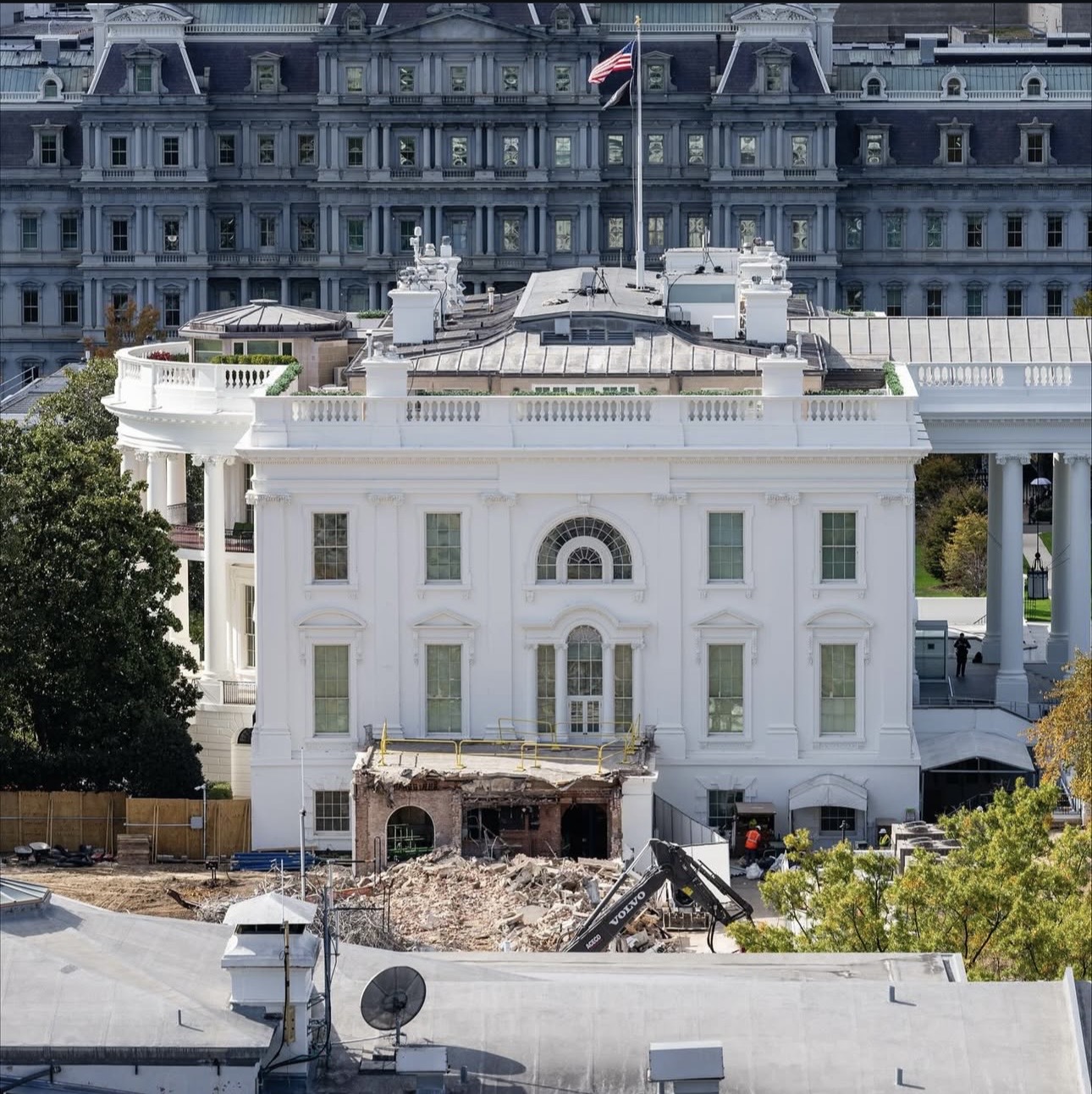
White House East Wing Renovation Project Continues into Holidays
Photo via @katiecouric Instagram
Christopher Panarese | Contributing Writer
The demolition of the East Wing of the White House to erect a 90,000 square foot ballroom continues into the holidays. At the same time, the media’s attention has been focused on blowing up alleged drug boats off the Venezuelan coast, the decision on extending health care tax credits, and sending $250 to families to be used for children’s education.
President Donald Trump’s plans to renovate the White House were announced during a press briefing on July 31. The ballroom, being designed to host state diners and diplomatic events, will be able to accommodate up to 650 people — a significant increase from the East Wing’s previous capacity of 200.
Many have speculated about whether Trump’s decision about the renovation, which began Oct. 20, is in poor taste or even if the project is even legal.
The history of the White House can be traced to when it was built in 1792. The British burned it down in 1814. It was reconstructed in 1817, but the temporary East Wing and West Wing were not added until 1902 during Theodore Roosevelt’s first term in office. Its purpose was to provide additional space for the president and his staff. The oval office was next to be completed in 1909 under William Howard Taft’s administration as an executive workspace.
The Oval Office was eventually relocated to the West Wing in 1934 when Franklin Roosevelt decided more office space was needed. Since then, there have been countless renovations that have cost hundreds of millions of dollars. While some of these renovations were as simple as adding solar panels, others involved complete interior reconstruction. Many of these improvements involved demolition or destruction of what is widely considered a piece of American history.
National media reports indicate that Trump claims to have privately raised over $250 million for the ballroom. However, the project has yet to receive approval from the National Capital Planning Commission or NCPC, which is responsible for signing off for construction on federal property. While the construction plans are still awaiting clearance from the NCPC, the NCPC has no jurisdiction over the demolition of the East Wing.
The New York Times, in late November, reported that Trump installed his former personal lawyer, Will Scharf, as chairman of the National Capital Planning Commission, which is supposed to review plans for the project. Scharf, according to the Times, has said there was no need to review Trump’s plans before he ordered the demolition of the East Wing. Trump has also fired the entire board of the Commission of Fine Arts, an independent federal agency established by Congress to advise the president on urban planning and historical preservation.
According to national media reports, people are concerned if the funds are being raised ethically. Large companies such as Meta platforms, Apple, and Amazon have pledged hundreds of billions of dollars to the U.S. economy as well as for the ballroom project. This has led people to question the motives of Trump and the Fortune 500 companies, according to media reports.
In late October, the White House provided a list of more than 35 ballroom project donors. Most are corporations. Normally, it benefits people when large companies pledge to pay for federal projects because such activity helps relieve financial pressure on the government. However, more than half the companies on the list are awaiting approval on large contracts with the government or are under investigation for unfair labor practices or consumer deception, according to media reports.
Congressional Democrats were quick to put together the “Stop Ballroom Bribery Act” in an attempt to combat the apparent conflict of interest. The bill prevents Trump from soliciting donations for projects on federal property, bans the public display or recognition of donors’ names, and ensures no donor may remain anonymous. Considering the fact that Republicans hold the majority in Congress, the legislation is not likely to survive.
Flyer News interviewed two University of Dayton for their thoughts about the renovation. Neither was born in the United States — one is from South America and the other is from Asia.
Both asked that their names not be used for this article.
The student from South America expressed concern about the history of the building and questioned the necessity of the demolition.
The student from Asia expressed fondness for the project and said, “The ballroom would be a good addition and could help build better relations with other nations.”
Cecelia Walsh, a student at Providence College, said, “We should not be destroying parts of the White House considering its historical significance and the current state of the U.S. Although its privately funded I believe the president should be focusing his time and resources elsewhere.”
The White House will continue to provide the public with project updates at whitehouse.gov/visit.